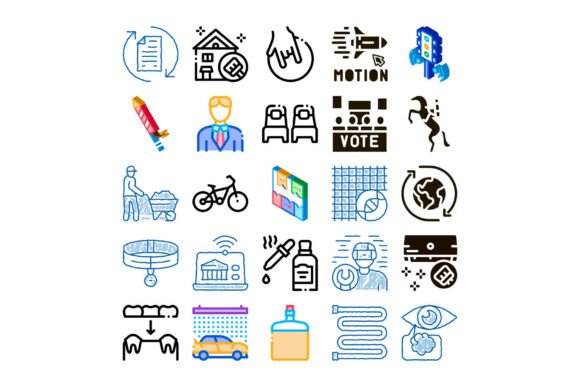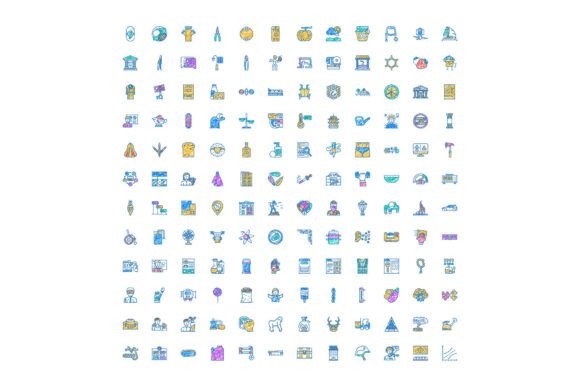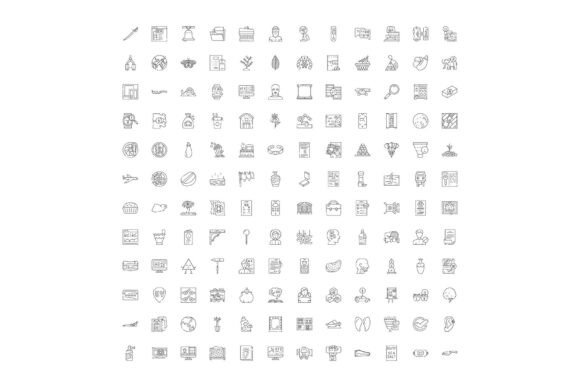
Collection of Varied Line Art Symbols an: A Versatile Resource for Modern Design
The Collection of Varied Line Art Symbols an is a comprehensive set of abstract outline icons that offer a unique and flexible approach to visual communication. These symbols, representing a wide range of objects, concepts, and activities, are ideal for modern design projects, web pages, mobile applications, and infographics. Their minimalist style allows them to blend seamlessly into various design contexts while maintaining clarity and impact.
Why People Are Drawn to Line Art Symbols
Designers, developers, and content creators often turn to line art symbols for their simplicity and adaptability. Unlike complex illustrations, these icons convey meaning through clean, recognizable shapes. This makes them particularly useful in environments where space is limited or where a subtle visual cue is needed. Whether you're designing a mobile app, creating a website layout, or developing an infographic, the Collection of Varied Line Art Symbols an can provide a cohesive and professional look without overwhelming the viewer.
Moreover, line art symbols are highly scalable. They maintain their clarity at any size, making them suitable for both large banners and small app buttons. Their versatility also extends to color schemes—many designs allow for easy customization, enabling users to match the icons with their brand’s palette or the overall aesthetic of their project.
Common Mistakes When Using Line Art Symbols
Despite their benefits, line art symbols can be misused if not approached carefully. One common mistake is selecting icons that are too similar in style or shape, leading to confusion or a lack of visual hierarchy. For example, using multiple icons that all have a similar stroke width or curvature can make it difficult for users to distinguish between different elements, especially in a busy interface.
Another frequent error is choosing symbols that are too abstract or unfamiliar. While minimalism is a strength, over-simplification can result in icons that are unclear or ambiguous. A symbol that looks like a generic circle or square might not communicate its intended meaning effectively. This is especially problematic when the icon represents a specific function or concept, such as "settings" or "notifications."
How to Avoid Missteps With Line Art Symbols
To avoid these issues, start by understanding the purpose of each icon. Ask yourself: Does this symbol clearly represent the idea it's meant to convey? If not, consider alternatives that are more intuitive. For instance, instead of using a vague abstract shape for "search," opt for a magnifying glass icon, which is universally recognized.
Additionally, test your design with real users. Conduct usability tests to see if people can easily interpret the icons. Feedback from actual users can reveal whether a symbol is effective or if it needs refinement. This step is crucial, especially when the icons are part of a user interface where clarity is essential.
Key Considerations Before Using Line Art Symbols
Before incorporating the Collection of Varied Line Art Symbols an into your project, take time to evaluate several factors. First, ensure that the icons are available in the right formats and resolutions for your needs. High-quality vector files (such as SVG) are ideal for scalability, while raster formats (like PNG) may be necessary for certain platforms.
Also, check licensing terms. Some icon sets come with restrictive licenses that limit how they can be used, especially in commercial projects. Make sure the Collection of Varied Line Art Symbols an is licensed appropriately for your intended use, whether it's for personal, educational, or business purposes.
Finally, consider the cultural context of the symbols. What may be clear in one region could be confusing in another. For global audiences, it's wise to choose icons that are widely understood or to include text labels as a backup.
Best Practices for Maximizing the Value of Line Art Symbols
To get the most out of the Collection of Varied Line Art Symbols an, adopt a strategic approach. Group related icons together to create visual consistency. For example, use a similar stroke style and color scheme for all navigation icons to reinforce their purpose and improve user experience.
Another effective strategy is to use line art symbols in combination with other design elements. Pairing icons with text or subtle animations can enhance their effectiveness and make the overall design more engaging. For instance, a simple "email" icon paired with a label and a hover effect can guide users toward important actions without cluttering the interface.
Real-World Applications of Line Art Symbols
Line art symbols are not just for digital interfaces. They can also be used in print materials, signage, and even physical products. A well-designed set of icons can simplify complex information, making it easier for users to navigate or understand a process. In educational settings, for example, icons can help illustrate concepts in a way that is visually appealing and easy to grasp.
In marketing, line art symbols can be used to highlight key points in presentations or social media posts. Their clean lines and minimalistic style make them ideal for capturing attention without distracting from the main message. By using the Collection of Varied Line Art Symbols an thoughtfully, marketers can create visuals that are both professional and impactful.
Final Thoughts on Line Art Symbols
The Collection of Varied Line Art Symbols an offers a powerful tool for designers and creators looking to enhance their visual communication. However, its success depends on thoughtful selection, proper application, and ongoing evaluation. By avoiding common pitfalls and following best practices, users can unlock the full potential of these icons and elevate the quality of their work.
Whether you're working on a website, an app, or an infographic, taking the time to understand and utilize line art symbols effectively can lead to better results, improved user experiences, and more satisfying outcomes for your audience.