Diverse Business Technology Healthcare L: A Unified Visual Language for Modern Professionals
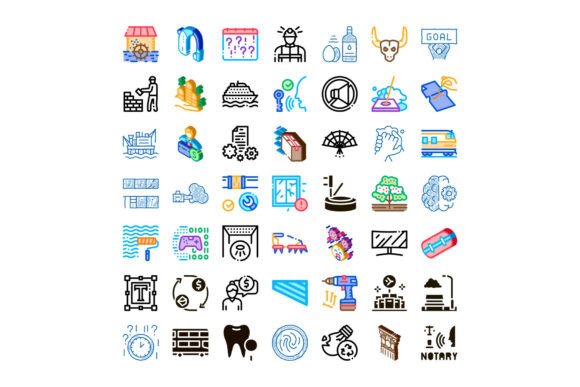
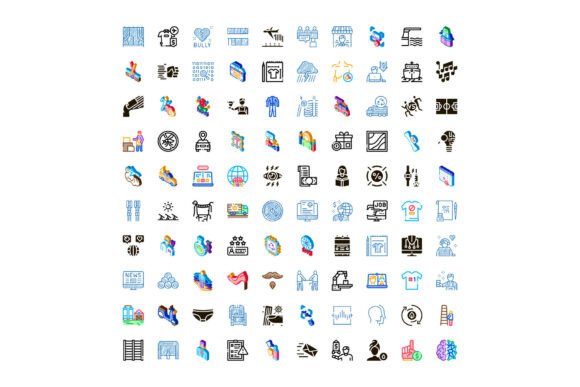
“Diverse Business Technology Healthcare L” refers not to a single product or platform, but to a curated set of linear icons designed to represent core concepts across four interconnected domains: business operations, digital technology, clinical and preventive healthcare, and daily lifestyle. The “L” stands for “linear”—a stylistic choice that prioritizes clarity, scalability, and visual consistency over decorative detail. These icons are purpose-built for professionals who design, communicate, or document complex cross-sector workflows—especially in infographics, dashboards, mobile interfaces, presentation decks, and internal training materials.
What Makes This Set Distinctive?
Unlike generic icon libraries that treat all subjects as stylistically equal, Diverse Business Technology Healthcare L intentionally balances thematic specificity with visual cohesion. Each category uses the same stroke weight, corner radius, and spacing logic—but adapts symbolic language to its domain’s conventions. For example, a “supply chain” icon may include subtle warehouse and transport elements, while a “telehealth” icon integrates both a video call symbol and a medical cross—without cluttering the form. Lifestyle icons avoid clichés (no generic coffee cups or running silhouettes) in favor of meaningful, inclusive representations: accessible mobility aids, balanced meal compositions, mental wellness cues, and home-based care activities.
This level of contextual awareness is rare. Many linear icon sets default to abstract or overly simplified metaphors—making them easy to scale but hard to interpret at a glance. Diverse Business Technology Healthcare L avoids that tradeoff by grounding each symbol in real-world usage patterns. A “data governance” icon doesn’t just show a database—it includes layered shields and bidirectional arrows to imply policy enforcement and interoperability. Similarly, a “patient intake” icon combines clipboard, calendar, and ID badge elements in a single, unbroken line structure.
How It Compares to Other Visual Resources
When evaluating icon resources, users typically weigh three dimensions: scope, semantic accuracy, and integration readiness. Diverse Business Technology Healthcare L excels in scope and accuracy—but differs meaningfully from alternatives in execution.
- General-purpose icon libraries (e.g., those offering thousands of icons across unrelated topics) often lack domain-specific nuance. You’ll find dozens of “cloud” icons, but few that distinguish between hybrid cloud architecture, cloud compliance auditing, or cloud-based EHR hosting. Diverse Business Technology Healthcare L fills those gaps deliberately—and omits low-value redundancy.
- Industry-specific icon packs tend to be deep but narrow—excellent for hospital IT teams, less useful for startups building health-tech SaaS platforms that span sales, engineering, and user support. This set bridges those boundaries: one icon family supports stakeholder mapping across departments without switching visual languages.
- Custom illustration services offer full creative control but require time, budget, and ongoing maintenance. Diverse Business Technology Healthcare L delivers production-ready assets with consistent licensing—ideal when speed, compliance, and cross-team alignment matter more than bespoke aesthetics.
The result is a middle path: more precise than generic tools, more flexible than vertical-only assets, and more practical than commissioning custom work for every new project.
Strengths and Real-World Fit
Professionals benefit most when their work sits at intersections. Consider a health system rolling out a new remote patient monitoring program. Teams involved include clinical operations (workflow design), IT (integration with existing EMR), marketing (patient onboarding materials), and HR (staff training). Using Diverse Business Technology Healthcare L, all groups can reference the same visual vocabulary: the same “device sync” icon appears in technical architecture diagrams, patient-facing app screens, and internal SOP documents—reducing cognitive load and misalignment.
Another strength lies in accessibility and responsiveness. Linear icons render cleanly at small sizes (16px for UI controls) and large formats (120px for printed posters), and their open shapes meet WCAG contrast and recognition guidelines better than filled or highly detailed alternatives. When paired with clear labels, they support multilingual audiences—especially valuable in global health initiatives or multinational enterprise deployments.
Tradeoffs and Limitations to Acknowledge
No icon set solves every problem—and understanding where Diverse Business Technology Healthcare L stops is as important as knowing where it starts.
It does not include animated variants, 3D renderings, or photorealistic assets. If your interface relies heavily on motion cues or immersive storytelling (e.g., patient education simulations), you’ll need complementary resources. It also avoids stylistic experimentation—no duotone, gradient, or hand-drawn variants. That’s intentional: consistency trumps novelty here.
While the set covers foundational concepts well—like “cybersecurity audit,” “value-based care,” “agile sprint planning,” or “nutrition tracking”—it doesn’t attempt exhaustive coverage of niche subtopics. You won’t find icons for “federal 340B drug pricing compliance” or “quantum-resistant encryption key management.” Those require either custom development or supplemental assets. That’s not a shortcoming; it’s a boundary that keeps the set focused, maintainable, and fast to navigate.
When to Choose This Set—And When to Look Elsewhere
Diverse Business Technology Healthcare L is especially appropriate when:
- You’re designing for mixed-audience communication—e.g., presenting a digital transformation roadmap to executives, clinicians, and engineers;
- Your team works across regulated environments (HIPAA, GDPR, SOC 2) and needs visuals that reflect compliance-aware thinking—not just surface-level tech imagery;
- You prioritize rapid iteration: launching MVP dashboards, updating internal wikis, or producing quarterly strategy reports without waiting for design approvals;
- Consistency matters more than differentiation—such as in enterprise-wide design systems where brand identity is expressed through color and typography, not icon style.
Conversely, consider alternatives if:
- Your project centers on emotional resonance over functional clarity—e.g., a mental health app targeting adolescents may benefit more from expressive, illustrated characters than clean linear forms;
- You require icons tied directly to proprietary frameworks (e.g., specific Agile methodology variants, internal taxonomy terms, or vendor-specific architecture diagrams);
- Your audience primarily engages via voice or screen-reader interfaces, where iconography plays little to no role in usability;
- You’re building a consumer-facing brand identity where distinct visual personality—rather than cross-domain neutrality—is the strategic goal.
Practical Integration Tips
Getting value from Diverse Business Technology Healthcare L isn’t just about downloading files—it’s about using them with intention. Start by auditing your current visual assets: identify recurring concepts that appear across business process maps, tech stack diagrams, clinical protocols, and wellness programs. Map those to matching icons. Then, establish lightweight usage guidelines—e.g., “All workflow diagrams use 24px linear icons with #4A5568 stroke color,” or “Icons in patient materials always appear with descriptive text, never standalone.”
Also consider pairing icons with microcopy that reinforces meaning. A “health data exchange” icon gains clarity when labeled “FHIR-compliant API connection” rather than just “data sharing.” That combination—precise symbol + contextual label—makes the set significantly more effective than either element alone.
Final Perspective
Diverse Business Technology Healthcare L serves a quiet but critical need: helping professionals speak the same visual language across traditionally siloed fields. It doesn’t replace deep domain expertise—but it lowers friction when translating between it. Whether you’re mapping care coordination pathways, documenting cloud migration steps, or illustrating workplace wellness metrics, this set offers a reliable, scalable, and thoughtfully bounded foundation. Its value emerges not in isolation, but in how seamlessly it connects ideas—across teams, tools, and timelines.