Diverse Set of Business Service and Indu
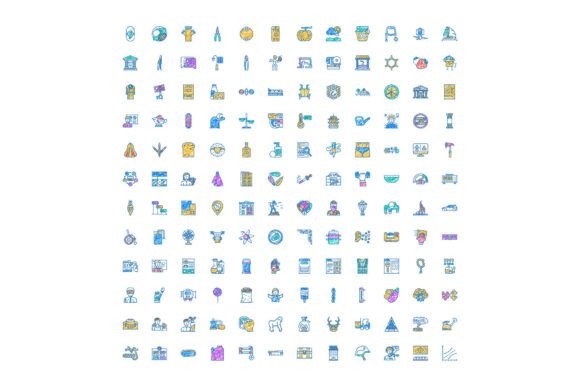
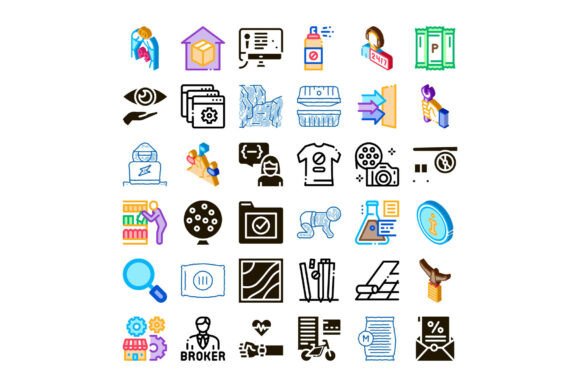
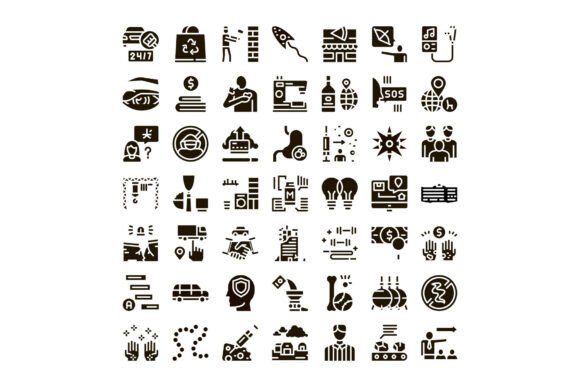
A Diverse Set of Business Service and Indu refers to a curated collection of clean, scalable line icons designed to visually represent a broad spectrum of business functions, service domains, and industry sectors. These icons span finance, health, logistics, construction, technology, and teamwork—offering consistent styling, intuitive symbolism, and technical readiness for use across websites, mobile applications, and data visualizations such as infographics.
Unlike generic icon libraries that prioritize quantity over contextual relevance, this set emphasizes functional clarity and cross-sector applicability. Each icon is crafted with minimal detail, high legibility at small sizes, and deliberate alignment in stroke weight, corner radius, and baseline positioning—ensuring visual cohesion when used together in dashboards, onboarding flows, or service catalogs.
Why Consider This Icon Set?
Designers, product managers, and content strategists often seek iconography that supports communication without requiring explanation. A Diverse Set of Business Service and Indu meets that need when projects involve multiple industries or service categories. For example, a SaaS platform serving healthcare providers, logistics coordinators, and construction project managers may require distinct yet stylistically unified icons to differentiate modules or user roles.
Readers evaluating such an icon set typically aim to solve one or more practical challenges: maintaining brand consistency across varied user journeys, reducing cognitive load in complex interfaces, or accelerating the creation of accessible, multilingual documentation. The value lies not in novelty, but in reliability—icons that convey meaning quickly and scale predictably across devices and contexts.
Benefits Across Use Cases
The primary benefit is efficiency in visual communication. Clean line icons from this set support rapid scanning in dashboards, intuitive navigation in mobile apps, and professional presentation in reports or investor-facing materials. Because they cover finance (e.g., transaction flow, balance sheet), health (e.g., patient record, telehealth), logistics (e.g., route map, warehouse), construction (e.g., blueprint, safety helmet), technology (e.g., cloud sync, API), and teamwork (e.g., collaborative editing, meeting), users avoid mixing disparate icon styles—or worse, resorting to ambiguous clip art.
Technical compatibility is another advantage. These icons are typically delivered in SVG format, supporting responsive sizing, CSS-based color control, and screen reader accessibility when paired with appropriate ARIA labels. Their linear design also lends itself well to dark mode interfaces and high-contrast requirements.
Tradeoffs and Practical Considerations
While breadth and consistency are strengths, the set’s scope entails tradeoffs. It does not include highly specialized symbols—for instance, niche medical devices, proprietary logistics protocols, or domain-specific engineering schematics. Users needing those will still require custom illustration or supplemental icon packs.
Also, “clean line” aesthetics prioritize universality over expressive detail. Icons representing abstract concepts—such as “trust,” “compliance,” or “scalability”—may rely on conventional metaphors (e.g., shield, checklist, upward arrow) rather than novel interpretations. That works well for broad audiences but may feel generic in contexts where distinctive visual identity is critical.
Another consideration is licensing. While many clean icon sets are available under permissive licenses, usage rights for commercial redistribution, white-labeling, or embedded SDKs vary. Reviewing license terms before integration—especially for enterprise applications—is essential.
When This Set Is a Strong Fit
A Diverse Set of Business Service and Indu aligns well with projects that emphasize clarity, scalability, and cross-industry relevance. It suits teams building:
- Multi-vertical SaaS platforms where users come from finance, healthcare, or supply chain backgrounds;
- Internal enterprise tools used across departments—HR, operations, IT, and field services;
- Data-rich infographics intended for stakeholder presentations or public reporting;
- Onboarding experiences requiring immediate recognition of service categories without text reliance;
- Websites or documentation systems aiming for WCAG-compliant, language-agnostic navigation cues.
In these cases, the set’s intentional coverage reduces the need to source, adapt, or reconcile icons from multiple origins—lowering design debt and improving long-term maintainability.
When Alternatives May Be More Appropriate
This set is less ideal when the project demands strong visual differentiation or narrative depth. For example:
- Branded illustration systems: If your product relies on custom characters, motion, or thematic motifs (e.g., a fintech app using animated coin animations), off-the-shelf line icons may clash with tone.
- Highly regulated domains: In clinical software or aviation logistics, regulatory guidelines sometimes mandate specific symbol standards (e.g., ISO 7000 or IEC 60417). Generic icons—even well-designed ones—may not satisfy compliance requirements without validation.
- Localized interface needs: Some cultures associate common symbols differently (e.g., envelope for messaging vs. mail delivery). When targeting specific regions, testing icon comprehension with local users remains advisable—regardless of icon origin.
- Minimalist or experimental UIs: Projects prioritizing extreme reduction—such as single-icon navigation bars or gesture-driven interfaces—may benefit more from bespoke, context-aware glyphs than standardized representations.
Making a Practical Decision
To determine whether a Diverse Set of Business Service and Indu fits your needs, start by auditing current or planned use cases. List the exact service categories, industry touchpoints, and interface contexts where icons will appear. Then ask:
- Do the required concepts appear in the set’s coverage? Cross-reference against published categories—not just broad labels like “health,” but specific actions or objects (e.g., “patient intake form,” “vital signs monitor”).
- Will consistency across these categories improve user understanding—or introduce ambiguity? Test a small subset with representative users to gauge recognition speed and accuracy.
- What level of customization is needed? If recoloring, resizing, or pairing with microcopy suffices, the set likely meets expectations. If you anticipate frequent overrides—rotating icons, adding annotations, or combining elements—custom development may offer better ROI.
- How will updates be managed? Evaluate whether the provider offers versioned releases, changelogs, and backward compatibility guarantees—important for long-lived applications.
Finally, consider implementation effort. SVG-based line icons integrate smoothly into modern front-end workflows, but teams using legacy CMS platforms or static site generators may need lightweight tooling for optimization or sprite generation. Assessing that overhead early avoids delays during handoff or QA.
Conclusion
A Diverse Set of Business Service and Indu serves a clear, practical purpose: enabling fast, consistent, and scalable visual communication across complex business environments. Its strength lies in thoughtful curation—not exhaustive coverage—and its utility emerges most clearly when aligned with goals around usability, maintainability, and cross-domain clarity. As with any design resource, its effectiveness depends less on inherent qualities and more on how deliberately it’s selected, tested, and applied within a specific context.